316L is the default austenitic stainless in process plant, and in a great many duties it is the right choice. In warm, chlorinated, aerated water it is often the wrong one.
Why 316L struggles
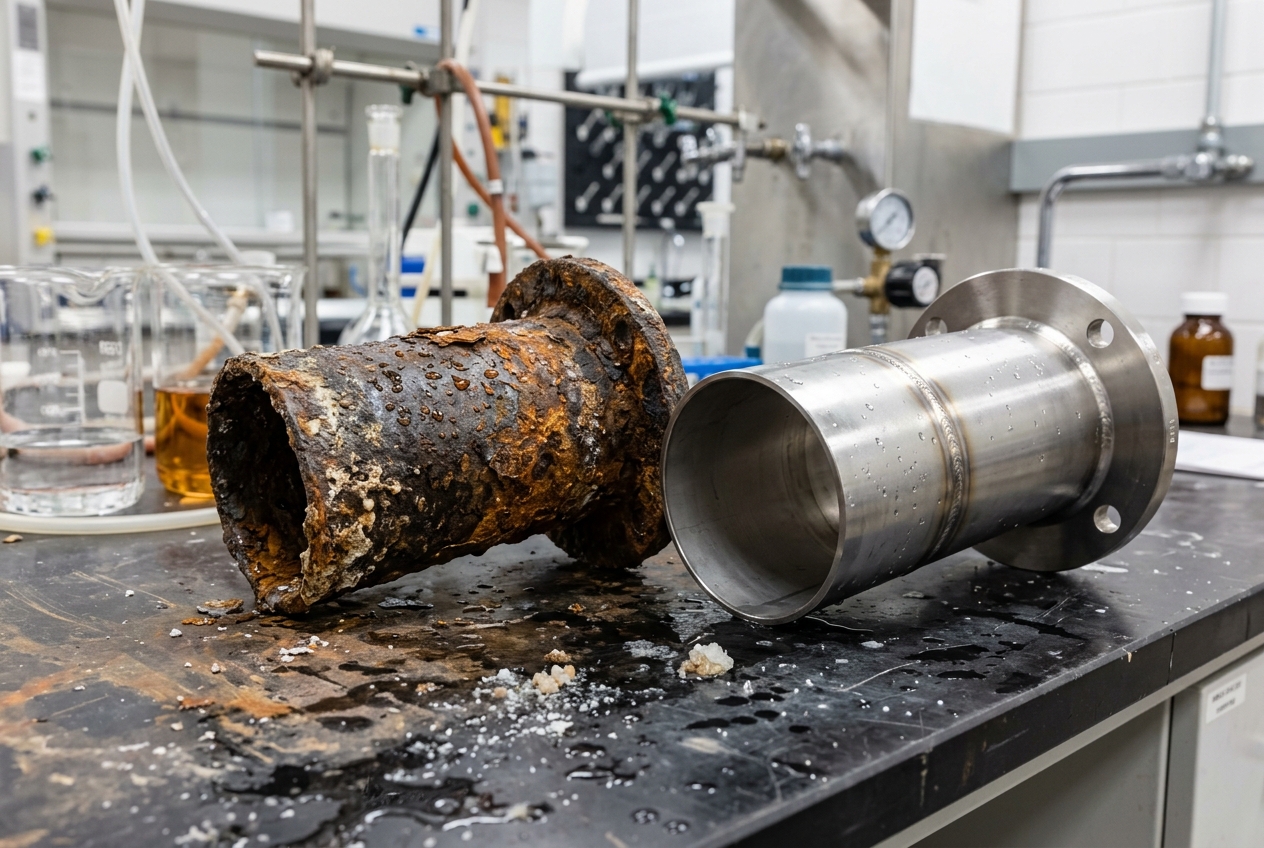
Chloride attack is local, not general. Pitting starts at a defect, a deposit or a crevice, and then drives itself. Two conditions make it far worse in the Gulf: temperature and chlorine dosing. Add stress and you open the door to chloride stress corrosion cracking, which 316L is particularly prone to above roughly 60 °C.
What duplex brings
UNS S32205 duplex has a roughly balanced austenite-ferrite microstructure, a higher chromium and molybdenum content and a nitrogen addition. In practice that means:
- Markedly higher pitting and crevice corrosion resistance
- Far better resistance to chloride stress corrosion cracking
- Roughly double the yield strength of 316L, so thinner, lighter sections
- A lower nickel content, which makes its price less volatile than the austenitics
What to watch
- Welding window. Heat input must be controlled from both sides. Too cold and ferrite dominates; too hot and intermetallic phases form. Both damage toughness and corrosion resistance.
- Temperature limit. Duplex is not for high temperature service; prolonged exposure above about 300 °C embrittles it.
- Forming. Higher strength means higher forming loads and more springback.
The commercial case
Compare on delivered weight, not price per tonne. Because duplex is stronger, the same duty frequently needs less metal. Add the cost of one unplanned shutdown to replace pitted 316L and the comparison is usually not close.
Tell us the fluid, the temperature, the chloride level and whether the line is dosed, and we will tell you which of the two we would supply, and whether 2507 is justified instead.